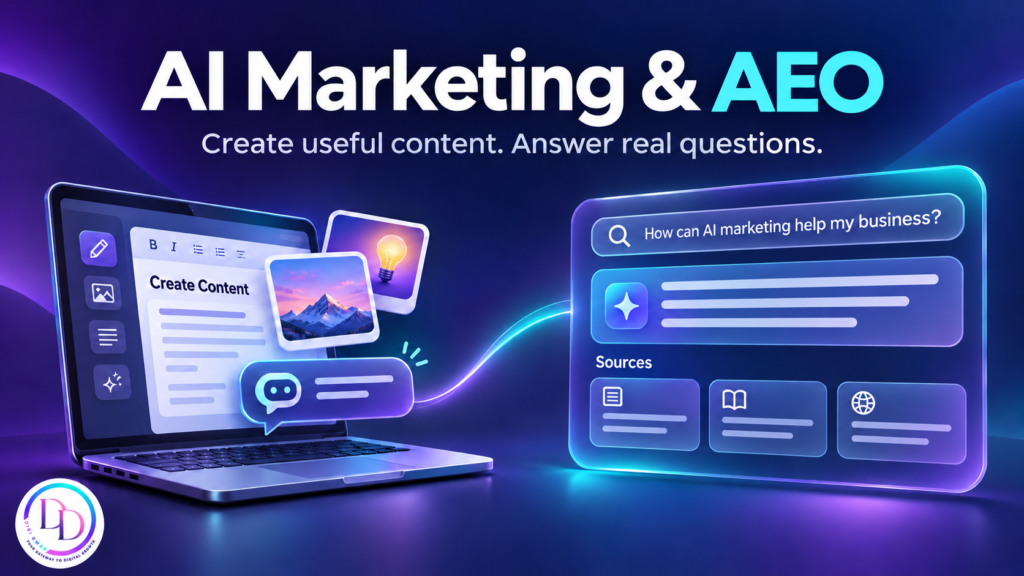
AI marketing and AEO can help businesses approach content creation and search visibility together. AI supports tasks such as preparing drafts and organising customer questions, while Answer Engine Optimization focuses on making website information clear and useful for answer-based search experiences.
For a business, this creates two connected tasks: producing useful marketing content and making reliable information available when customers search for answers.
AI marketing and AEO address different parts of that process. AI marketing helps teams research, prepare and review marketing work. Answer Engine Optimization, or AEO, focuses on making content useful in search experiences that provide direct answers.
Neither removes the need for a clear website, accurate information or a worthwhile service. Here is how businesses can bring them together.
What Is AI Marketing?
AI marketing means using artificial intelligence to support marketing activities, such as organising customer questions, drafting content, developing creative ideas and reviewing campaign information.
For a small business, practical uses include:
- Turning approved service details into a first draft.
- Preparing alternative advertising headlines.
- Grouping common customer questions into article topics.
- Creating a brief for promotional designs.
- Summarising anonymised enquiry feedback for review.
The quality of the result depends on the information you provide and how carefully you check it.
For example, a website developer can supply its actual package details and ask AI to prepare a comparison table. Someone must still confirm the prices, exclusions and delivery conditions before publishing.
If you are exploring creative tools, read our guide to Adobe’s integrations with ChatGPT and Claude.
What Is Answer Engine Optimization?
Answer Engine Optimization describes the work of making information clear, accessible and useful for systems that answer questions directly.
These experiences include Google’s AI search features and assistants that search the web and cite sources.
A customer might ask:
- What does monthly SEO include?
- How much should I budget for a business website?
- Is Google Ads spend included in an agency’s management fee?
- What information should I prepare before hiring a developer?
A useful page answers the question clearly, explains the conditions and gives readers enough detail to make a decision.
AEO is not a guaranteed route into an AI answer. Google states that its AI search features do not require special optimisation beyond the relevant search requirements and SEO fundamentals. See Google’s guidance on AI features and websites.
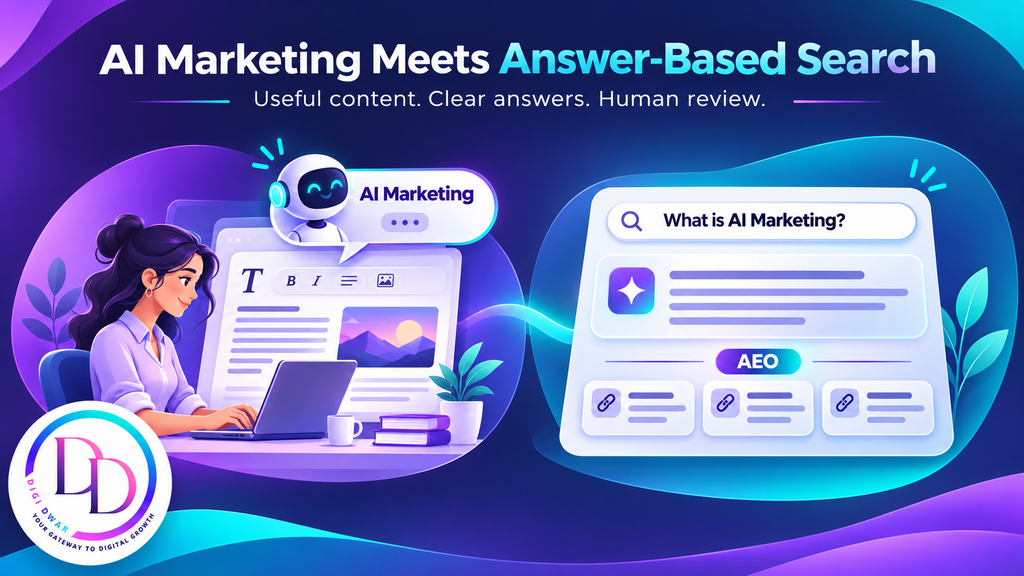
AI Marketing and AEO: What Is the Difference?
| Area | AI marketing | AEO |
|---|---|---|
| Main purpose | Support marketing preparation and analysis | Make information useful for answer-based discovery |
| Typical work | Content drafts, creative briefs and campaign ideas | Clear explanations, accessible pages and reliable evidence |
| Example | Drafting an article about website packages | Explaining package inclusions so readers can compare them |
| Human responsibility | Check accuracy, relevance and permissions | Keep answers accurate, supported and current |
The connection is straightforward: AI can help prepare a draft, while an AEO approach encourages you to examine whether that draft actually answers the customer’s question.
Publishing an AI-generated article does not automatically make it suitable for AI search.
AEO vs SEO: Do Businesses Need Both?
SEO covers the work that helps search engines discover, understand and present your website. It includes technical access, useful content, internal links and a good page experience.
AEO places particular attention on how that information answers questions.
Much of the practical work overlaps. A clear service page can help someone arriving through a conventional search result and someone following a source cited in an AI answer.
Businesses should therefore build on their existing SEO work rather than abandon it for a separate collection of “AI ranking tricks.”
Google’s guide to generative AI search also explains that special AI text files and special schema markup are not required for inclusion in its generative search experiences.
How AI Marketing and AEO Can Work Together
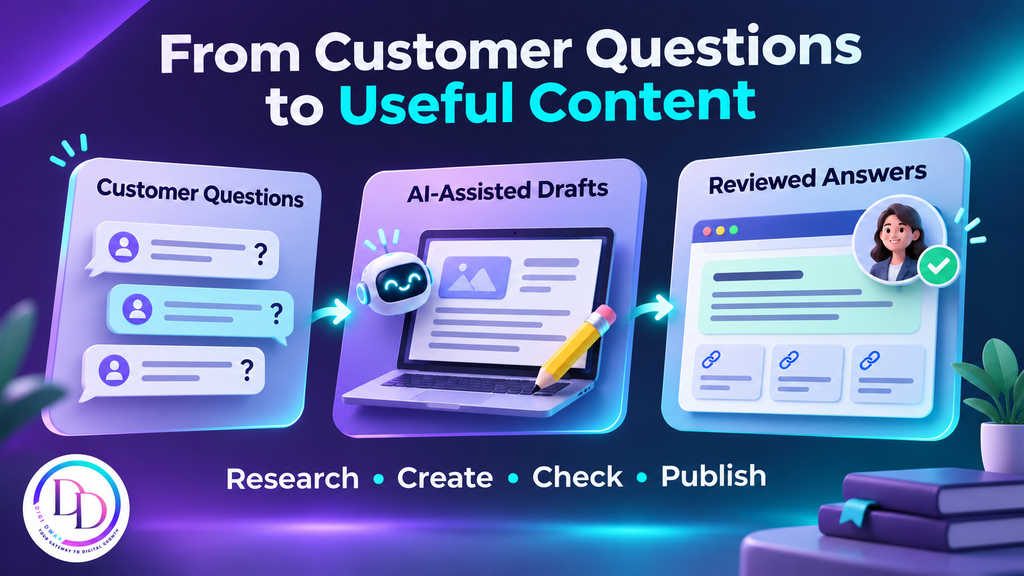
1. Start with Actual Customer Questions
Collect questions from sales conversations, contact forms and service discussions.
A digital marketing agency might regularly hear:
- Do I need SEO or Google Ads first?
- Can I start with a small website?
- Who owns the website after delivery?
- Are advertising charges separate from management fees?
- How will I know whether enquiries are relevant?
Use AI to organise these questions into themes. Then choose a topic your business can answer with direct knowledge.
Avoid publishing several articles that repeat the same answer with slightly different keywords.
2. Answer the Main Question Early
When someone opens an article about Google Ads management fees, they should quickly understand what the fee covers and whether advertising spend is separate.
For example:
Does a Google Ads management fee include ad spend?
Usually, these are separate charges. The management fee pays for the agreed campaign work, while ad spend pays for advertising delivery through Google. Customers should check their provider’s proposal for the exact arrangement.
The explanation can then cover setup charges, tracking, reporting and landing-page work.
This structure helps the reader find an answer before exploring the details. It does not guarantee that a search engine will quote the passage.
3. Add Information from Your Own Work
General explanations are easy to find. Your own experience can make an article more useful.
Explain how you scope a project, what clients need to supply and which factors change the work involved.
For website development, that might include:
- Whether the client has approved content and photographs.
- Whether existing pages need to be moved.
- Which forms or integrations are required.
- Who handles domain and hosting access.
- What testing and handover include.
Where you share project results, provide context and distinguish recorded figures from business outcomes.
You can explore examples of DigiDwar’s work in our client portfolio.
4. Connect Articles to Relevant Service Pages
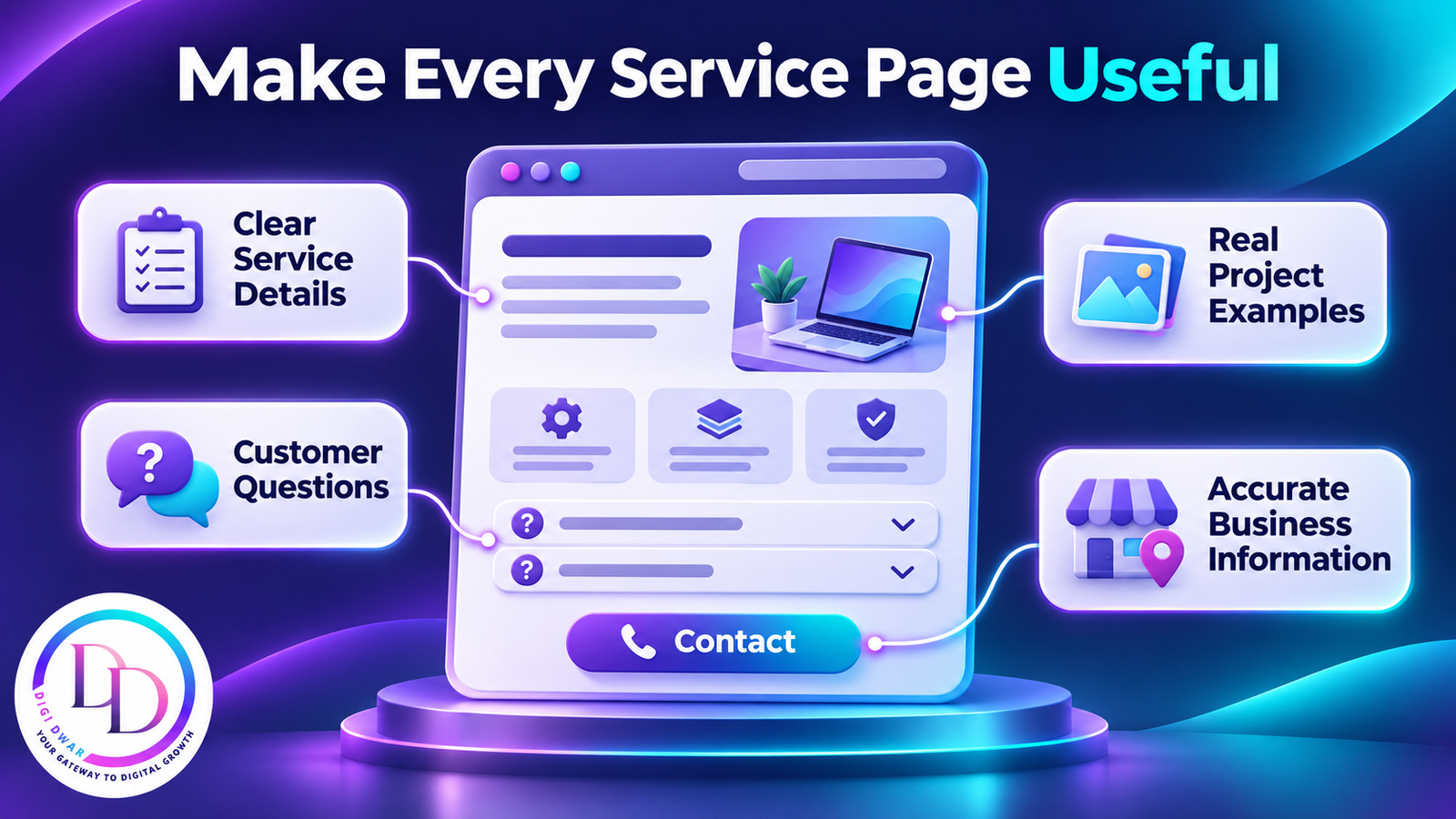
An article should help a reader take the next appropriate step.
A guide about preparing a website brief can link to your website development service. An explanation of ongoing search work can link to your SEO service.
Use descriptive link text so the destination is clear. Place the link where it helps the reader, rather than adding a list of unrelated services to every section.
For example, a business planning a new site can compare the scope of DigiDwar’s website development services.
5. Keep Business Information Consistent
Review your business name, contact details, service areas and package information across your website and public profiles.
If a package changes, update the relevant pages and any articles that describe it. Explain whether a price is a starting price and what could change the quotation.
Consistency helps customers understand your offer. It also reduces the chance of your own pages giving conflicting answers.
How to Approach Visibility in ChatGPT Search with AI Marketing and AEO
If you want your content considered for ChatGPT search, technical access matters.
OpenAI identifies OAI-SearchBot as the crawler used for surfacing websites in ChatGPT search features. Its publisher guidance explains that sites should allow the relevant access for inclusion in summaries and snippets. Allowing access does not guarantee placement. See the OpenAI publisher FAQ.
Have your developer review crawler and hosting settings where needed. Keep those decisions separate from decisions about allowing content to be used for model training.
Beyond access, concentrate on publishing information that is accurate, understandable and useful enough for someone to consult directly.
Use AI Marketing and AEO Tools with a Clear Review Process
Choose a tool around the task you need to complete.
| Task | What AI can help prepare | What you should check |
|---|---|---|
| Article planning | Questions and an outline | Whether the topic adds useful information |
| Service copy | A readable first draft | Scope, prices, claims and exclusions |
| Creative work | Design ideas and variations | Brand accuracy and asset permissions |
| Campaign review | A summary of supplied data | Calculations, context and conclusions |
| Customer communication | Reply templates | Suitability for the actual enquiry |
Do not upload private customer information simply to make a prompt more detailed. An anonymised example is often enough.
Never allow a draft to introduce invented testimonials, certifications or campaign results.
What Should You Measure?
Measure whether your work is reaching relevant people and helping them take useful actions.
Start with:
- Search impressions and clicks.
- Queries and pages receiving visibility.
- Visits referred from AI assistants, where identifiable.
- Visits from articles to relevant service pages.
- Recorded enquiries and their relevance.
- Follow-up outcomes.
Keep these measurements separate. A search impression is not a visit, and a visit is not a confirmed customer.
If you manually check whether an assistant mentions your business, record the question and date. One response is an observation, not a stable ranking report.
How to Start with AI Marketing and AEO
Begin with one service and one customer question.
Review your existing page, identify what is missing and use AI to help prepare an improvement. Add your own knowledge, verify the details and connect the article to the relevant service.
After publishing, monitor the page’s search data and enquiry feedback. Use those findings to decide the next improvement.
AI marketing and AEO work best as part of an ongoing process of explaining your business clearly—not as a reason to publish large amounts of similar content.
Frequently Asked Questions
Can AI-written content appear in search results?
Using AI does not establish the quality of a page. Review the content for accuracy, originality and usefulness before publishing, and follow the relevant platform’s guidance.
Can AEO replace SEO?
No. Technical accessibility, clear site structure and useful content remain important. AEO describes an emphasis on answers within that broader work.
How do I get cited in AI Overviews?
There is no guaranteed submission or wording formula. Follow Google’s guidance, maintain accessible pages and provide reliable information that answers the topic well.
Does adding an FAQ guarantee AI visibility?
No. Add FAQs when they answer genuine questions. A question-and-answer format alone does not guarantee citations or rankings.
Should a small business use AI marketing and AEO?
They can provide a useful way to organise marketing work and improve customer explanations. Start with a specific task and assess whether the result helps your audience.
Make Your Website More Useful to Potential Customers
DigiDwar supports businesses in Greater Noida and across Delhi NCR with website development, SEO services, Google Ads and Meta Ads management.
If your website needs clearer service information or a practical content plan, contact DigiDwar or call +91 87896 19750 for a free initial consultation.